Understanding Stablecoin Chains
Stablecoin chains are blockchains purpose-built or optimized to facilitate fast, cost-effective payments using stablecoins—digital currencies pegged to fiat assets like the US dollar or euro. Rather than operating as general-purpose blockchain networks that support diverse applications, stablecoin chains prioritize payment efficiency, transaction finality, and integration with financial infrastructure. They represent the evolution of blockchain technology from speculative asset trading platforms into practical payment settlement systems for businesses and individuals.
A stablecoin chain combines three essential components: the stablecoin itself (typically backed by fiat reserves), the blockchain network that processes transactions, and the APIs and infrastructure that integrate stablecoins with traditional payment workflows. This combination eliminates the volatility problem that has historically prevented cryptocurrency adoption in payments—users and merchants no longer need to hold volatile tokens to transact on blockchain networks.
How Stablecoins Maintain Their Stability
The most common form of stablecoin relies on fiat-backing, where every token in circulation is supported by equivalent reserves held in segregated bank accounts or government securities. For example, Circle’s USDC is backed by approximately 90 percent short-term US Treasuries or repurchase agreements, with the remainder held in cash. This reserve structure ensures that holders can redeem stablecoins at face value, maintaining the 1:1 peg with the underlying currency.
Different types of stablecoins use alternative backing mechanisms. Crypto-collateralized stablecoins like DAI rely on overcollateralized on-chain collateral with liquidation mechanisms, while algorithmic designs attempt to maintain pegs through supply management. However, fiat-backed stablecoins dominate real-world payment use cases due to their regulatory compatibility and operational reliability.
Leading Stablecoin Chains and Networks
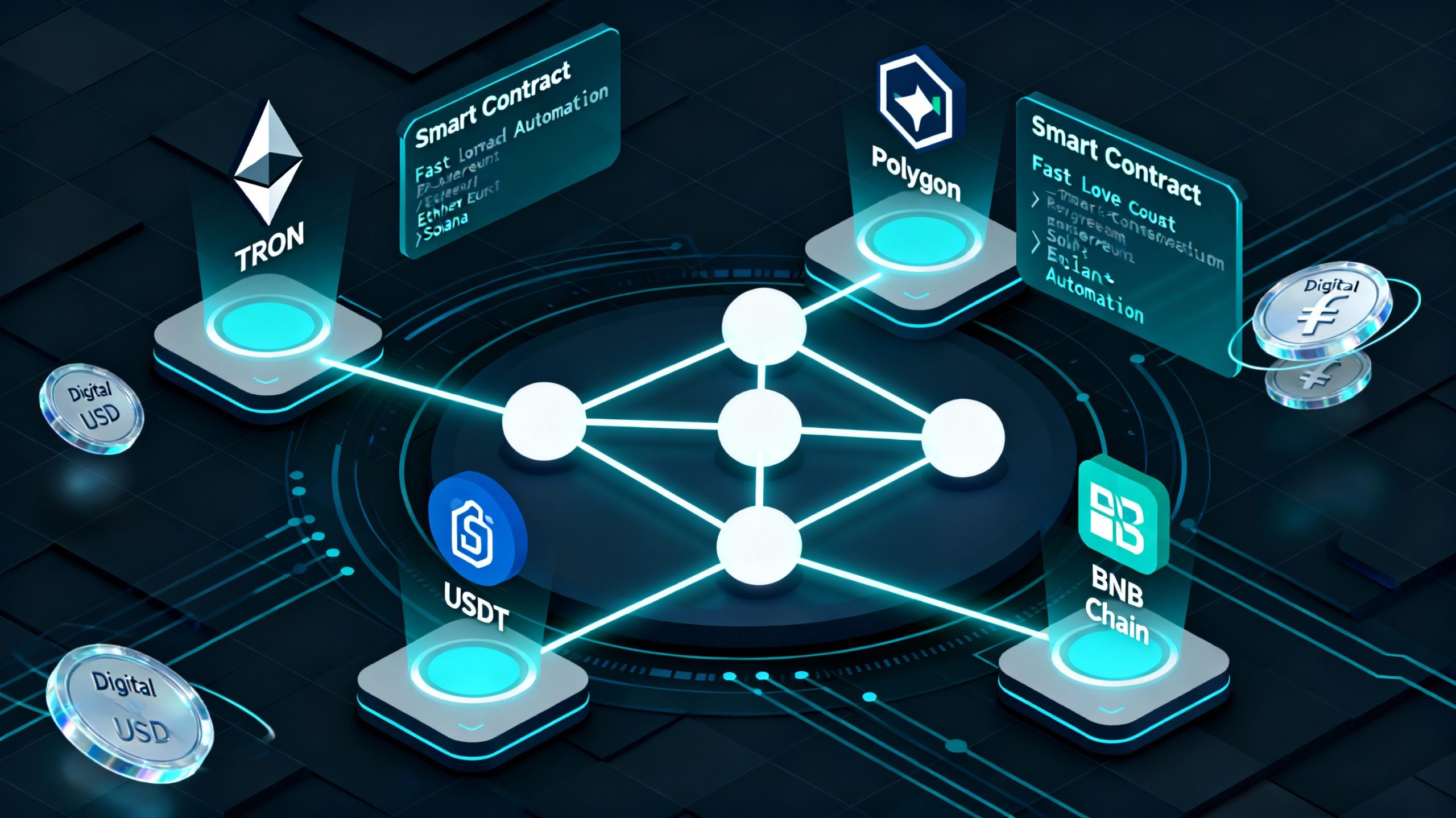
The stablecoin ecosystem concentrates across several primary blockchains, each serving distinct geographic and operational needs:
TRON has emerged as the dominant stablecoin settlement network, hosting over 46 percent of global USDT supply—approximately $78 billion as of September 2025. The network processes over $6-7 trillion in stablecoin transactions annually, with more than 75 percent of worldwide USDT transfers running through TRON. This dominance stems from TRON’s efficiency model: transaction fees are typically fractions of a cent, enabling microtransactions and small-value transfers that form the backbone of financial inclusion in emerging markets. The network now supports 334 million total accounts with approximately 2.92 million daily active users, with 68 percent accessing via mobile wallets—a critical advantage in regions where smartphones serve as the primary gateway to financial services.
Ethereum established itself as the foundational blockchain for stablecoin innovation, enabling complex financial instruments through its smart contract capabilities. Multiple major stablecoins including USDC, USDT, and DAI operate on Ethereum, supported by a robust DeFi ecosystem comprising lending platforms and decentralized exchanges. However, transaction costs on Ethereum main network remain higher than layer-two solutions or alternative chains, making it better suited for larger transactions or DeFi integrations rather than high-frequency retail payments.
Solana has become a leading network for fast stablecoin settlements, offering transaction confirmations in nearly milliseconds with network fees typically amounting to a fraction of a cent. Stablecoin transfers frequently exceed tens of billions of dollars per month across Solana’s DeFi ecosystem, payments infrastructure, and transfer networks. The speed and low-cost characteristics make Solana particularly attractive for retail crypto users and traders managing stablecoin positions.
Polygon operates as a layer-two scaling solution built on Ethereum, combining Ethereum’s security with significantly reduced transaction costs and faster settlement. The network maintains approximately 5-second settlement times while supporting all major stablecoins including USDC and USDT. Polygon has attracted millions of monthly active users and serves banks, fintechs, payment service providers, and e-commerce platforms seeking programmable, efficient payment flows.
BNB Chain has evolved beyond trading infrastructure to support comprehensive stablecoin payment ecosystems. The network accommodates USDT, USDC, FDUSD, and regional stablecoins while providing integration capabilities for DEX APIs and payment gateways for real-time settlements. BNB Chain’s recent partnership with Better Payment Network aims to create a multi-stablecoin global settlement network connecting regional stablecoins including BBRL, TRYB, cNGN, MEXAS, and EURI.
Base and Optimism represent optimistic layer-two scaling solutions that inherit Ethereum’s security while offering significantly lower fees and faster throughput compared to Ethereum mainnet. These networks support substantial stablecoin liquidity and serve as payment infrastructure for various fintech and payment applications.
Emerging Purpose-Built Stablecoin Chains
The latest development in the stablecoin chain landscape involves companies building dedicated layer-one blockchains specifically designed for stablecoin payments rather than adapting general-purpose networks.
Circle’s Arc represents one such innovation, announced in August 2025 as an open layer-one blockchain explicitly designed as “the home for stablecoin finance.” Arc’s revolutionary feature is its use of USDC itself as the native gas token, meaning transaction fees are denominated in dollar-stable value rather than volatile cryptocurrency. This design eliminates unpredictability in transaction costs—businesses can budget fees in precise dollar amounts rather than managing price volatility of network tokens. Arc further implements an Ethereum-compatible variant of the EIP-1559 fee model to smooth volatility through time-averaging of usage, ensuring stable and predictable pricing for financial institutions.
Stripe’s Tempo similarly represents a purpose-built layer-one blockchain for payment processing, also Ethereum-compatible to enable developers to seamlessly transition smart contracts while optimizing for stablecoin settlement and payment efficiency. These purpose-built networks reflect a strategic shift driven by two primary pressures: functionality and economics.
The functionality imperative reflects that as stablecoins gain traction in mainstream business applications, operational demands for security, regulatory compliance, and high-throughput transactions favor platforms explicitly designed for these requirements rather than general-purpose chains balancing censorship resistance, decentralization, and broader blockchain use cases. The economic drivers stem from the substantial operational costs of maintaining true decentralization and censorship resistance; if pseudonymity and censorship resistance aren’t essential (as in regulated financial services), infrastructure can be redesigned more cost-effectively while maintaining the speed and programmability advantages of blockchain settlement.
Payment Advantages Over Traditional Systems
Stablecoin chains fundamentally transform payment infrastructure through multiple mechanisms:
Settlement Speed: Traditional payment systems require 1-3 business days during banking hours only, remaining reversible throughout the process. Stablecoin settlements complete in seconds to minutes and operate 24/7/365 without business hour cutoffs. For international transfers using SWIFT, the gap widens dramatically—blockchain settlements typically complete in under 3 minutes globally compared to 3-5 business days for correspondent banking transfers.
Cost Efficiency: Blockchain payment infrastructure reduces cross-border remittance costs by up to 80 percent compared to traditional correspondent banking. One specific comparison from McKinsey data indicates that some blockchain-based payment providers charge approximately one-fifth of what traditional providers charge for cross-border payments. Rather than multiple intermediaries each levying fees, stablecoin settlements eliminate intermediary layers while reducing operational overhead.
No Chargebacks and Final Settlement: Once blockchain transactions achieve finality, they become permanent and immutable parts of the distributed ledger, eliminating chargebacks entirely. This contrasts sharply with traditional payment systems where merchants face ongoing chargeback risk, operational burden processing disputes, and potential revenue losses to chargeback fraud. The irreversible nature of blockchain settlement protects businesses from significant losses while eliminating the administrative overhead of chargeback processing.
Programmable and Automated Logic: Beyond simple value transfer, stablecoin chains enable smart contracts—self-executing code that automatically enforces financial agreements when conditions are met. This enables applications including automated escrow with built-in yield generation, conditional payment release based on shipment or delivery verification, automatic currency conversion based on market conditions, and supply chain finance triggered by working capital requirements. Traditional payment systems cannot execute arbitrary business logic; they generate alerts requiring human intervention.
Enhanced Transparency and Compliance: Real-time tracking enables businesses to monitor payment status end-to-end, eliminating the routing opacity of international transfers. Smart contracts can automatically check payments for anti-money-laundering and know-your-customer compliance through digital processes, creating immutable audit trails and supporting tax reporting and audit requirements.
Regulatory Compliance Framework
As stablecoin payment infrastructure matures, regulatory requirements have crystallized around anti-money-laundering (AML) and know-your-customer (KYC) compliance. The GENIUS Act, enacted in July 2025 in the United States, explicitly brings stablecoin transactions under Bank Secrecy Act requirements equivalent to traditional wire transfers.
Required Compliance Elements:
Know-Your-Customer (KYC) Processes: Stablecoin issuers and service providers must verify customer identity and beneficial ownership, matching standards applied by banks and money service businesses. Enhanced procedures must assess stablecoin use cases and detect regulatory arbitrage risks.
Real-Time Sanctions Screening: Before processing any transaction, providers must conduct real-time screening against the US Treasury’s Office of Foreign Assets Control (OFAC) sanctions lists. This requirement demands continuous monitoring rather than periodic batch processing—each transaction trigger requires immediate sanctions checks.
Transaction Monitoring and Suspicious Activity Reporting: Firms must actively detect and respond to suspicious behavior across their platforms through automated transaction monitoring systems. Any detected red flags—such as structuring, unusual velocity, or interactions with high-risk addresses—must trigger immediate alerts and appropriate responses. Previously acceptable monthly compliance spreadsheets are now inadequate; regulators expect 24/7 real-time AML monitoring equivalent to electronic fiat payments.
Technical Enforcement Capabilities: Stablecoin issuers must maintain internal technical systems allowing them to freeze, seize, or render tokens inactive when instructed by lawful authorities. This enforcement-ready infrastructure must enable rapid response to regulatory requests without requiring blockchain consensus or multi-signature approvals.
Audit Trails and Record Retention: Every transaction and compliance decision must be logged in comprehensive audit trails that regulators can review on demand. Issuers face requirements for monthly public reserve attestations, annual financial audits, and suspicious activity reports (SARs) for any suspected illicit activity. Firms must remain “exam-ready” at all times with documented histories of customer due diligence, transaction monitoring alerts, and case resolutions demonstrating proper compliance steps.
Use Cases Driving Adoption
The practical applications of stablecoin chains extend across multiple industries and geographies:
Cross-Border Payments and Remittances: Stablecoin infrastructure enables individuals and businesses to send payments globally in minutes rather than days, with minimal fees compared to traditional remittance networks. This particularly benefits workers sending money home to countries with unstable currencies or limited banking infrastructure.
B2B Settlement and Trade Finance: Businesses use stablecoin chains for supplier payments, invoice settlements, and trade finance automation. Smart contracts can encode complex payment terms including tiered releases based on delivery verification, automatic currency conversion, and conditional fund release upon contractual fulfillment.
Treasury and Cash Management: Corporations utilize stablecoin chains for 24/7 liquidity management, internal fund transfers across global subsidiaries, and cash positioning optimization without traditional banking hour constraints.
Merchant Payment Processing: Retailers and e-commerce platforms accept stablecoins directly through checkout integration, settling instantly without chargebacks while accessing global customer bases. Merchants can hold settled funds in stablecoins for operational needs or convert to local fiat immediately, eliminating exposure to cryptocurrency volatility.
Financial Inclusion: In emerging markets with unstable local currencies or limited banking access, TRON and other low-cost stablecoin chains have effectively emerged as “digital dollar rails,” enabling unbanked and underbanked populations to access stable value storage and cross-border payment capabilities via smartphone wallets. This proves particularly important in regions where cryptocurrency adoption is high relative to banking infrastructure.
Market Scale and Growth
The stablecoin payment ecosystem has achieved substantial scale. Global stablecoin market capitalization reached approximately $255 billion as of June 2025, with nearly 99 percent pegged to US dollars. Stablecoins facilitate approximately $30 billion in daily transactions currently, with projections suggesting this could expand to $10 billion annually in cross-border settlement cost savings alone by 2030.
Transaction volumes demonstrate the infrastructure’s operational capacity: TRON alone processes $6-7 trillion in annual stablecoin transactions with daily USDT volumes exceeding $25 billion. The infrastructure accommodates everything from large institutional transfers to millions of daily microtransactions by retail users in emerging markets. Monthly programmable stablecoin transaction volumes have grown from $450 billion to $710 billion within a single year, indicating accelerating institutional adoption.
Stablecoin chains represent a fundamental evolution in payment infrastructure, combining the speed and programmability of blockchain technology with the price stability necessary for mainstream financial use. As regulatory frameworks solidify and purpose-built networks optimize for payment-specific requirements, stablecoin chains are transitioning from speculative blockchain applications into essential payment settlement infrastructure for businesses and individuals globally.
Ready to start your cryptocurrency journey?
If you’re interested in exploring the world of crypto trading, here are some trusted platforms where you can create an account:
- Binance – The world’s largest cryptocurrency exchange by volume.
- Bybit – A top choice for derivatives trading with an intuitive interface.
- OKX – A comprehensive platform featuring spot, futures, DeFi, and a powerful Web3 wallet.
- KuCoin – Known for its vast selection of altcoins and user-friendly mobile app.
These platforms offer innovative features and a secure environment for trading and learning about cryptocurrencies. Join today and start exploring the opportunities in this exciting space!
 Want to stay updated with the latest insights and discussions on cryptocurrency?
Join our crypto community for news, discussions, and market updates: CryptoBCC on Youtube | Instagram | Telegram | Pinterest | Facebook | Discord | Tiktok | Threads | X(Twitter).
 For collaborations and inquiries: CryptoBCC.com@gmail.com
Disclaimer: This is not investment advice. Cryptocurrency investments carry high risk. Always conduct your own research.