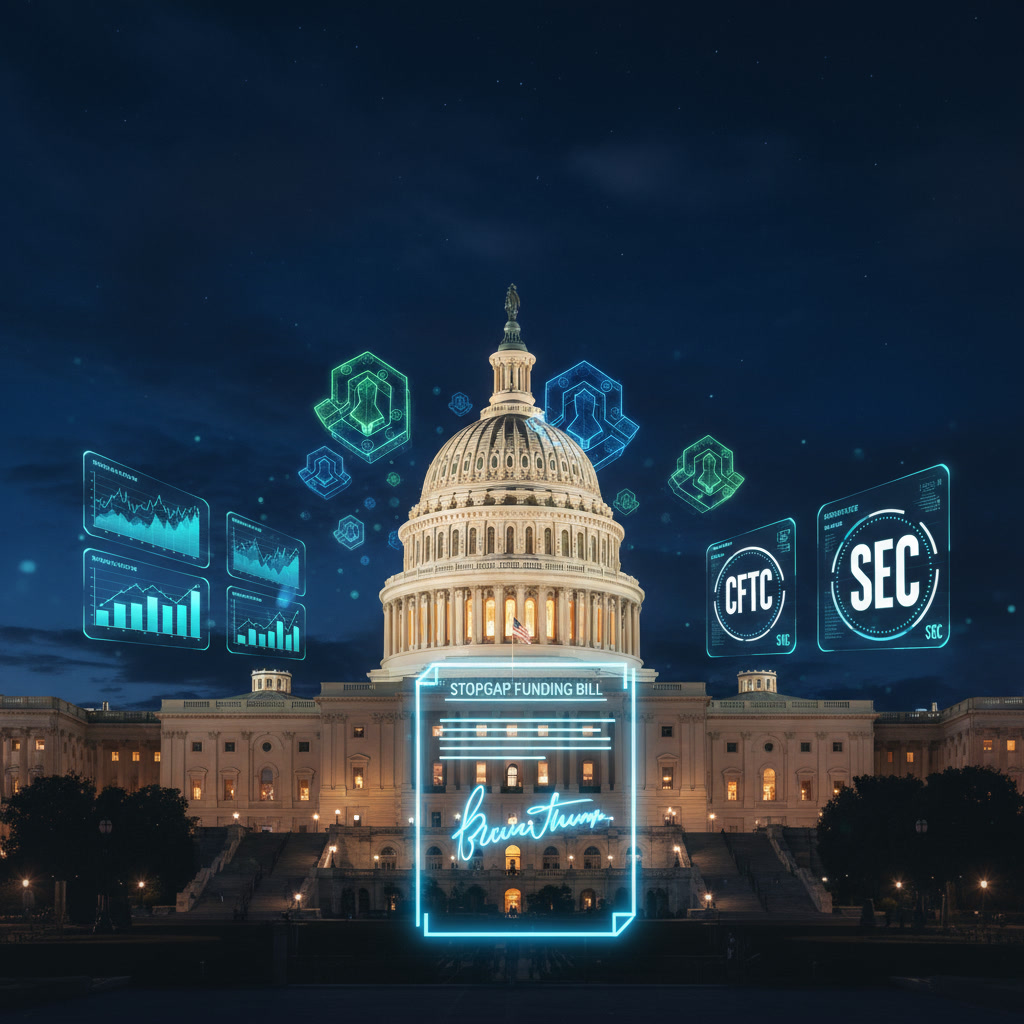
After six weeks of federal paralysis, the United States government has officially reopened. Late Wednesday night, President Donald Trump signed a short-term funding bill passed by the House of Representatives, ending a 42-day shutdown and allowing federal agencies — including the SEC, CFTC, IRS, and OCC — to resume normal operations.
The bill, approved by a 222–209 vote, extends funding through January 2026, giving Congress a three-month window to negotiate a longer-term budget deal. The swift signing, completed just after 10:00 p.m. ET, immediately restored federal capacity to process permits, enforce regulations, and resume delayed legislative priorities — including several critical developments for the cryptocurrency and financial sectors.
Three-Month Funding Deal Restores Government Operations
The temporary measure passed with bipartisan support — 216 Republicans and 6 Democrats voting in favor — marks the end of the longest government shutdown in recent U.S. history. The funding bridge ensures that furloughed employees can return to work, public services can resume, and federal oversight mechanisms can operate again after weeks of suspension.
While the deal only covers a short window, it provides breathing room for lawmakers to continue negotiations on long-term spending priorities. More importantly, it allows the machinery of government — and particularly its regulatory arms — to begin clearing the significant backlog accumulated during the shutdown.
The rapid enactment of the bill immediately reduced administrative lag. Agencies most impacted by the shutdown, such as the Securities and Exchange Commission (SEC) and the Commodity Futures Trading Commission (CFTC), can now reinitiate stalled processes related to filings, enforcement, and public consultation.
Crypto Regulation Back on Track: Senate Agriculture Committee Introduces Draft Framework
One of the first legislative actions following the reopening is the Senate Agriculture Committee’s release of a draft framework for digital asset markets. The proposal seeks to clearly define the CFTC’s authority over spot crypto markets, long a gray area that has led to uncertainty for both investors and industry participants.
In parallel, the Senate has scheduled a confirmation hearing for Mike Selig, the nominee to chair the CFTC. Analysts note that this move signals a renewed focus on establishing clear regulatory oversight for the crypto industry — a topic that had been effectively frozen during the shutdown.
If confirmed, Selig’s leadership is expected to accelerate policy coordination between the CFTC and SEC, particularly on delineating jurisdictional boundaries and creating standardized compliance procedures for spot and derivatives markets.
“A limited number of staff in the SEC’s Division of Corporation Finance will remain available for fee-related and emergency inquiries. All other functions will cease,”
— SEC Operational Notice, October 9, 2025
This statement, issued prior to the shutdown, underscores how deeply market oversight was disrupted — and why the government’s reopening is pivotal for both regulatory efficiency and market stability.
SEC, CFTC Resume Full Operations — ETF, IPO, and Filing Backlogs to Be Cleared
With full funding restored, regulators like the SEC and CFTC can resume reviewing ETF applications, listing requests, and other pending market disclosures. During shutdowns, the SEC retains only a skeleton crew to manage urgent operations, leaving most filings unprocessed and IPO pipelines frozen.
Historically, these shutdowns have caused measurable slowdowns in capital markets — delaying public listings, reducing liquidity, and dampening investor sentiment. The resumption of regular functions is therefore expected to accelerate ETF approvals, restore the IPO flow, and renew confidence among issuers and traders.
The CFTC, responsible for supervising derivatives and crypto-linked futures, had also scaled down significantly during the shutdown. Its internal “shutdown contingency plan” restricted all nonessential functions under the Anti-Deficiency Act, halting enforcement actions and product reviews.
“In the event of a lapse in appropriations, the CFTC must suspend all non-exempt activities under the Anti-Deficiency Act.”
— J. Christopher Giancarlo, Former CFTC Chairman, December 21, 2018
Now, with funding restored, both agencies are expected to prioritize clearing their backlogs and resuming normal turnaround times for compliance and registration requests.
How the Reopening Impacts Crypto, Finance, and Policy Development
Beyond regulatory resumption, several key initiatives will move forward:
-
Senate Agriculture Committee’s crypto framework — Clarifies the CFTC’s role in spot crypto market oversight.
-
CFTC leadership confirmation — Mike Selig’s hearing will determine future direction in digital asset regulation.
-
Resumption of SEC reviews — Pending ETF and IPO filings are expected to advance within weeks.
-
IRS and OCC policy consultations — Public comment periods for financial and digital asset rulemaking will reopen.
For crypto and fintech firms, this means that stalled consultations, regulatory guidance, and public hearings will return to the legislative calendar. Companies should revisit their pending submissions, update compliance documentation, and prepare for renewed engagement with agencies as operations normalize.
Practical Guidance for Crypto Companies and Investors
-
Review Pending Filings: Ensure any paused submissions to the SEC or CFTC are up to date with the latest data.
-
Monitor the Senate’s Legislative Calendar: The draft crypto market framework and CFTC chair confirmation are critical milestones.
-
Prepare for New Deadlines: Agencies will likely release revised timelines for feedback and compliance once they fully resume.
-
Expect a Temporary Backlog: Processing may take several weeks as agencies address accumulated cases.
-
Stay Informed on ETF and Listing Updates: Renewed momentum could bring new opportunities for digital asset products.
Conclusion: A Reset Moment for Markets and Policy
The reopening of the U.S. government marks more than an administrative recovery — it’s a reset for regulatory and financial momentum. As agencies return to full capacity and Congress refocuses on market frameworks, the coming months could see meaningful progress in clarifying crypto oversight, resolving ETF backlogs, and restoring investor confidence.
While the temporary nature of the funding bill means another fiscal showdown could loom in early 2026, the short-term victory provides crucial time for lawmakers and regulators to make progress on long-awaited digital asset legislation.
The message is clear: after 42 days of uncertainty, Washington is open again — and so is the path toward a more coherent and forward-looking U.S. crypto policy.
Ready to start your cryptocurrency journey?
If you’re interested in exploring the world of crypto trading, here are some trusted platforms where you can create an account:
- Binance – The world’s largest cryptocurrency exchange by volume.
- Bybit – A top choice for derivatives trading with an intuitive interface.
- OKX – A comprehensive platform featuring spot, futures, DeFi, and a powerful Web3 wallet.
- KuCoin – Known for its vast selection of altcoins and user-friendly mobile app.
These platforms offer innovative features and a secure environment for trading and learning about cryptocurrencies. Join today and start exploring the opportunities in this exciting space!
 Want to stay updated with the latest insights and discussions on cryptocurrency?
Join our crypto community for news, discussions, and market updates: CryptoBCC on Youtube | Telegram | Facebook | Discord | X(Twitter)
 For collaborations and inquiries: CryptoBCC.com@gmail.com
Disclaimer: This is not investment advice. Cryptocurrency investments carry high risk. Always conduct your own research.