South Korea’s financial landscape has undergone a dramatic transformation in late 2025, marked by a striking divergence between two once-vibrant asset classes. While the KOSPI index has surged to unprecedented heights with daily trading volumes reaching 34.04 trillion won, cryptocurrency markets have experienced a precipitous collapse, with trading volumes on major domestic exchanges plummeting by more than 80%. This stark contrast reveals a fundamental shift in investor sentiment and capital allocation, as South Korean retail investors increasingly abandon digital assets in favor of traditional equities.
The Collapse of Cryptocurrency Trading Volume
The decline in cryptocurrency activity within South Korea has been nothing short of dramatic. Upbit, the nation’s largest cryptocurrency exchange, witnessed its daily trading volume plummet from approximately 9 billion dollars in December 2024 to just 1.78 billion dollars by November 2025—an 80% contraction. More strikingly, Upbit’s historical peak occurred on December 3, 2024, during the country’s martial law crisis, when volumes temporarily surged to 27.45 billion dollars before rapidly collapsing. By November 2025, trading volumes had fallen to their lowest levels since late 2023.
The situation at Bithumb, South Korea’s second-largest cryptocurrency platform, mirrors this catastrophic decline. Daily trading volumes dropped from approximately 2.45 billion dollars in December 2024 to around 890 million dollars by November 2025—a 69% decrease representing the loss of nearly two-thirds of its liquidity. Notably, the volatility of trading volumes has also significantly decreased, suggesting not merely a cyclical downturn but a comprehensive retreat of retail investor interest.
Combined data from South Korea’s five largest cryptocurrency exchanges—Upbit, Bithumb, Coinone, Korbit, and Gopax—reveals a total daily trading volume of just 5.57 trillion won, down 45% since the beginning of the year. This contraction is so severe that the entire cryptocurrency trading volume has shrunk to merely 16.37% of the KOSPI’s daily trading volume, underscoring a massive reallocation of capital.
The disengagement of South Korean cryptocurrency traders is further confirmed by search trend data. Google’s search index for Bitcoin in South Korea stands at 44, representing a 66% decline from its peak of 100 at the end of 2024. This metric provides compelling evidence that even interest in cryptocurrency as a topic has fundamentally shifted among the Korean population.
The KOSPI’s Historic Bull Run
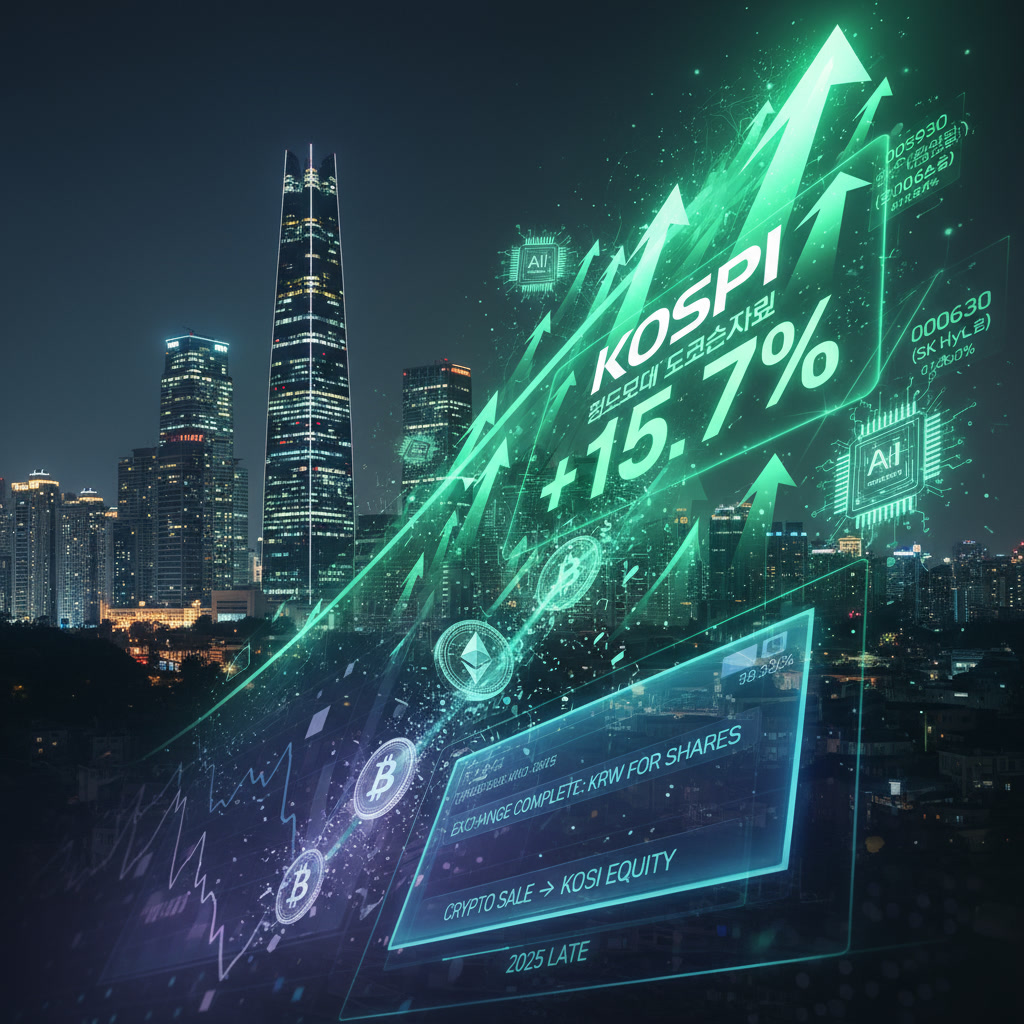
Contrasting sharply with cryptocurrency’s collapse, South Korea’s benchmark KOSPI index has delivered exceptional performance throughout 2025. By November 2025, the KOSPI had climbed approximately 71.8% from the start of the year, establishing it as the best-performing major stock market globally. This surge stands 49 percentage points ahead of the S&P 500, marking the widest outperformance margin in over two decades.
The index reached multiple record highs throughout October and early November 2025, achieving 16 intraday records in October alone and demonstrating a near-21% increase during that month. Daily trading volumes have surged dramatically, reaching 34.04 trillion won by early November—a 207% increase from the 11.05 trillion won recorded on January 2, the first trading day of 2025.
This unprecedented rally has been powered by several converging factors. The semiconductor sector, particularly Samsung Electronics and SK Hynix, has led the charge, driven by robust global demand for artificial intelligence chips and high-bandwidth memory (HBM). Samsung’s stock has increased approximately 95% year-to-date, while SK Hynix has experienced an extraordinary 242% gain. Together, these two companies constitute nearly 30% of the KOSPI index, accounting for a market capitalization exceeding 1,000 trillion won.
The Semiconductor and AI Growth Engine
The extraordinary performance of Samsung Electronics and SK Hynix cannot be divorced from the global AI revolution and South Korea’s strategic positioning within it. Both companies have secured landmark partnerships that underscore their centrality to next-generation AI infrastructure. SK Hynix reported record quarterly revenue and profit, driven by surging demand for high-bandwidth memory utilized in generative AI chipsets.
The APEC CEO Summit held in Gyeongju in late October 2025 crystallized this momentum. NVIDIA CEO Jensen Huang announced a historic commitment to deploy over 260,000 NVIDIA GPUs across South Korean sovereign clouds and industrial AI factories in partnership with Samsung Electronics, SK Hynix, Hyundai, and the South Korean government. This initiative represents one of the largest national investments in agentic and physical AI to date.
Additionally, Samsung and SK Hynix have formed strategic partnerships with OpenAI as part of the company’s $500 billion Stargate project, securing their roles as primary suppliers of high-bandwidth memory semiconductors. These partnerships have dramatically elevated investor confidence in both companies’ futures and reinforced the perception that South Korea stands at the heart of the global AI industrial revolution.
Political Support and Pro-Market Policies
President Lee Jae-myung’s administration has implemented a comprehensive series of pro-market policies explicitly designed to boost the KOSPI and eliminate what economists term the “Korea discount”—the persistent undervaluation of Korean companies relative to their global counterparts. Lee, who took office in June 2025, has made reaching 5,000 points on the KOSPI a defining campaign pledge.
The ruling Democratic Party has aggressively pursued a multi-pronged legislative strategy to achieve this goal. In July 2025, the party passed its first Commercial Act revision, expanding directors’ fiduciary duties from “the company” to encompass “the company and its shareholders.” In August, despite opposition from the People Power Party, lawmakers forced through a second Commercial Act revision mandating cumulative voting systems at large listed companies, empowering minority shareholders in director elections.
The government is now pushing for additional market-stimulating measures, including separate taxation on dividend income and mandatory share buyback provisions. The proposed dividend tax reform would reduce the maximum tax rate on dividends from high-dividend-payout companies from 45% to as low as 35%, or even 25% according to more aggressive proposals, thereby lowering shareholders’ tax burdens and incentivizing increased dividend payments.
These policy initiatives reflect what market observers describe as an unprecedented coalition between government, corporate leadership, and institutional investors to reinvigorate the Korean stock market. One Democratic Party politician noted that “the ruling party is swaying the hearts of 14 million individual investors with the ‘5,000+ KOSPI’ promise,” while another suggested that “Tổng thống Lee will be remembered like someone who promoted both the stock market and cryptocurrency—a pattern similar to Trump today.”
The Flight from Cryptocurrency
Amid this stock market euphoria, South Korea’s traditionally vibrant cryptocurrency sector has been relegated to secondary status. Specialist AB Kuai Dong observed that “South Korean retail investors who were previously active on cryptocurrency markets have now shifted their focus to stocks.” This represents a profound departure from South Korea’s historical identity as a major global cryptocurrency trading hub, where over 18 million citizens—approximately one-third of the population—engage with digital assets.
The reallocation of capital has been particularly striking given that South Korea’s cryptocurrency exchanges, particularly Upbit and Bithumb, have historically served as crucial price discovery mechanisms for global digital assets. The listing of new cryptocurrencies on these platforms has traditionally generated powerful upward momentum in global markets. However, this influence has been dramatically diminished by the current capital flight.
The comparison in asset performance starkly illustrates investors’ new preferences. While Bitcoin has gained only 11% since the beginning of 2025, the KOSPI has surged 71.8%—a performance gap exceeding 60 percentage points. This disparity has become a powerful signal to investors that equity markets, particularly those concentrated in semiconductor and AI-related sectors, offer far superior returns in the current environment.
Lee’s Paradoxical Relationship with Cryptocurrency
Notably, while President Lee and his administration have effectively sidelined the cryptocurrency market through their focus on stock market promotion, they have maintained a stated commitment to digital asset development. During his election campaign, Lee pledged to approve Bitcoin spot ETFs, promote stablecoin applications, and even discussed stablecoins on television.
In June 2025, the ruling Democratic Party proposed the Digital Asset Basic Act, which would legalize stablecoin issuance by domestic companies maintaining a minimum of 500 million won in equity capital and holding sufficient reserves. The bill also mentions the creation of a new Digital Asset Committee to coordinate industry policy. These proposals represent significant steps toward a modernized regulatory framework for cryptocurrency in South Korea.
However, these pro-cryptocurrency policy initiatives have been overshadowed by the administration’s intensive focus on stock market promotion. While Ki Young Ju, CEO of CryptoQuant, acknowledged the government’s stablecoin proposals and the importance of reducing real estate speculation, the macroeconomic incentives have clearly favored equity markets. The central bank, under Governor Rhee Chang-yong, has also expressed concerns that private stablecoins could undermine monetary policy effectiveness and remain skeptical of non-bank-issued digital assets.
The Question of Permanence
As of early November 2025, market dynamics have begun showing signs of volatility. On Tuesday following the APEC summit, the stock market declined 2.7%, while cryptocurrency markets also registered downward pressure. This suggests that the current rally, while historically significant, may not represent a permanent reordering of South Korean capital allocation.
Several factors could determine whether this divergence persists. First, the sustainability of KOSPI gains depends significantly on continued semiconductor demand and the realization of AI supercycle expectations. If global AI infrastructure investment disappoints or faces headwinds, the stock market rally could reverse sharply.
Second, regulatory developments regarding cryptocurrency could accelerate or retard digital asset adoption. The passage of comprehensive stablecoin legislation, along with Bitcoin spot ETF approvals, could reinvigorate South Korean retail interest in digital assets. Conversely, additional regulatory crackdowns or policy neglect could entrench the current bearish sentiment.
Third, macroeconomic factors including interest rates, inflation, and currency movements will influence both equity and cryptocurrency valuations. Rising interest rates or inflation could particularly pressure growth-oriented technology stocks, while potentially benefiting alternative assets.
Conclusion
South Korea’s financial markets have undergone a striking transformation in 2025. What was once a balanced ecosystem featuring world-leading cryptocurrency exchanges alongside robust equity markets has evolved into an environment where traditional assets dramatically dominate investor capital allocation. The KOSPI’s 71.8% year-to-date surge contrasts sharply with cryptocurrency volumes declining 80%, reflecting a comprehensive reordering of investor priorities toward sectors positioned to benefit from the global AI revolution.
This shift has been enabled by a unique convergence of technological momentum in semiconductor manufacturing, strategic geopolitical positioning through partnerships with leading AI companies, aggressive pro-market fiscal and regulatory policies, and the psychological power of record-setting equity market performance.
Whether this represents a temporary cyclical divergence or a permanent structural shift in Korean investor preferences remains an open question. However, the current trajectory demonstrates how macroeconomic incentives, policy frameworks, and technological development can rapidly reshape capital allocation patterns within even historically entrenched financial sectors. For now, South Korea’s investors have voted decisively for equities over cryptocurrencies—a choice that has proven remarkably profitable in the short term but whose long-term implications remain uncertain.
Ready to start your cryptocurrency journey?
If you’re interested in exploring the world of crypto trading, here are some trusted platforms where you can create an account:
- Binance – The world’s largest cryptocurrency exchange by volume.
- Bybit – A top choice for derivatives trading with an intuitive interface.
- OKX – A comprehensive platform featuring spot, futures, DeFi, and a powerful Web3 wallet.
- KuCoin – Known for its vast selection of altcoins and user-friendly mobile app.
These platforms offer innovative features and a secure environment for trading and learning about cryptocurrencies. Join today and start exploring the opportunities in this exciting space!
 Want to stay updated with the latest insights and discussions on cryptocurrency?
Join our crypto community for news, discussions, and market updates: CryptoBCC on Youtube | Instagram | Telegram | Pinterest | Facebook | Discord | Tiktok | Threads | X(Twitter).
 For collaborations and inquiries: CryptoBCC.com@gmail.com
Disclaimer: This is not investment advice. Cryptocurrency investments carry high risk. Always conduct your own research.