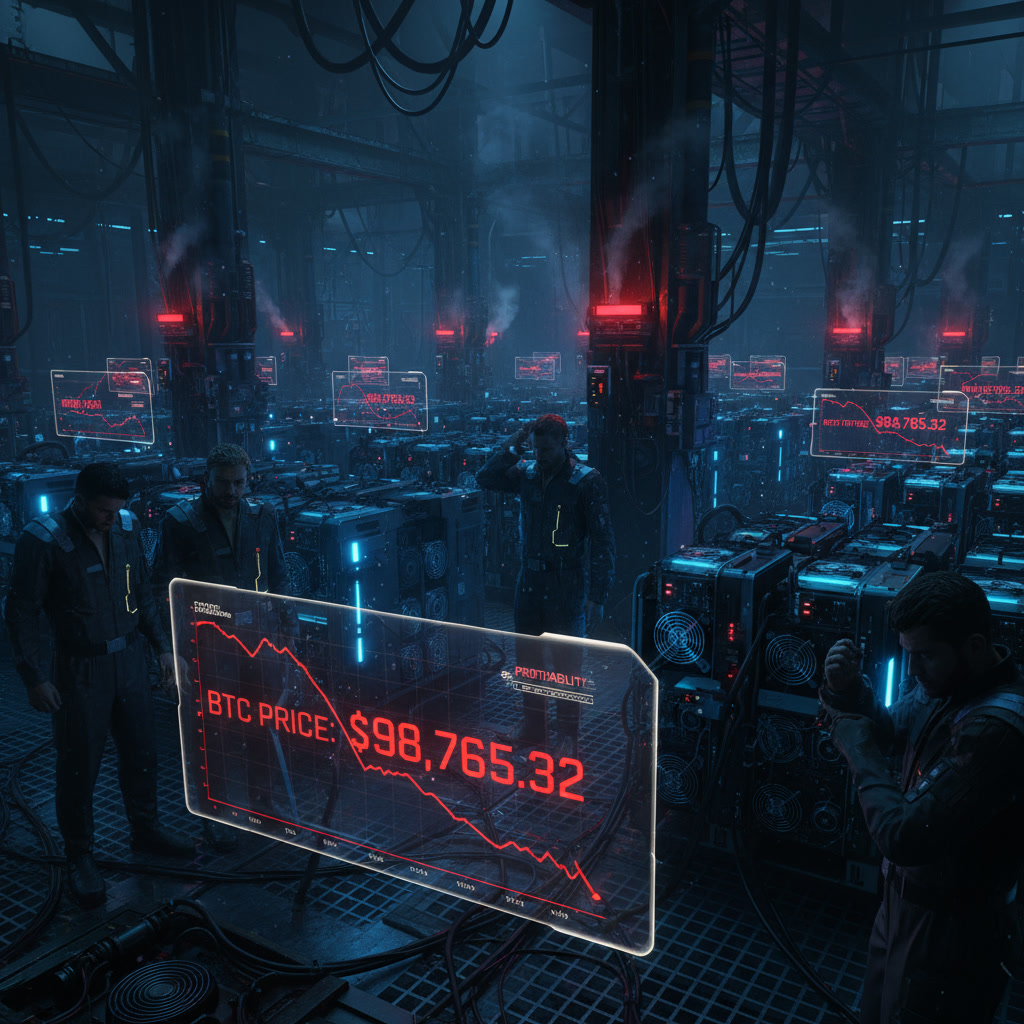
In recent days, the crypto-mining industry has come under significant pressure as Bitcoin (BTC) slipped below the psychologically and operationally important threshold of $100,000. According to data from the mining pool F2Pool, miners using some of the most efficient machines are barely breaking even, while those with older or less energy-efficient rigs are now operating at a loss.
1. The Current Mining Economy
At an electricity cost of $0.06 per kWh, mining rigs achieving 27.5 W per terahash (W/TH) break even only when Bitcoin price hovers around $97,000. Machines with less favourable efficiency or in regions with higher electricity costs are already in the red.
For very high-efficiency rigs, such as the Antminer S21 XP Hyd. (12 W/TH), the break-even Bitcoin price drops to around $41,585, meaning these machines remain viable even if BTC falls substantially. On the other side of the spectrum, older models like the Whatsminer M53 (needing BTC at around $100,694) and the Antminer S19 (requiring ~$118,641) are facing major losses.
2. Why the Pressure Is Mounting
Several interconnected factors are weighing on miners:
-
Electricity costs: The largest ongoing operational cost. As noted, even at $0.06/kWh only the best machines are break-even. If costs are higher (which they often are globally), the pressure is magnified.
-
Hardware efficiency: Advances in mining hardware mean that older units become uncompetitive quickly. Efficiency (measured in W/TH) directly impacts how low a miner can tolerate BTC prices.
-
Bitcoin price drop: The fall of BTC below $100 K shrinks revenue per mined coin, squeezing margins.
-
Increasing network difficulty / hash rate: Rising competition means that each miner’s share of rewards gradually declines unless capacity and efficiency increase.
-
Fixed costs and depreciation: Besides electricity, there are equipment purchase costs, cooling/infrastructure, maintenance, and sometimes debt – all of which must be amortised.
A recent analysis by mining-industry commentators asserts: “Mining remains profitable, but cost control is key. Only those with very low electricity costs (≤ $0.10/kWh) and efficient rigs can sustain profitability.”
3. The Bigger Picture & Implications
-
Consolidation and exit risk: Miners who cannot cover their costs may be forced to shut down operations, sell equipment, or leave the business altogether, especially those using older rigs.
-
Impact on decentralisation: If many smaller miners exit and only large, efficient operations survive, network decentralisation may suffer—an issue often discussed in mining literature.
-
Energy and sustainability concerns: Mining is still energy-intensive. Reduced profitability may prompt shutdowns, but also shifts towards low-cost energy or more sustainable setups.
-
Market sentiment and price feedback loop: If miner stress leads to selling of mined BTC or assets, this could feed back into the market and potentially exacerbate downward price moves.
4. What Miners Should Consider Doing
-
Evaluate electricity costs carefully and renegotiate where possible; relocating or tapping into lower cost/renewable power may be decisive.
-
Upgrade hardware: If operating older rigs, the payback period may become too long; investing in high-efficiency machines could be vital.
-
Monitor break-even and stay agile: Know exactly what BTC price covers your costs and have contingency plans if the market dips further.
-
Diversify operational models: Some miners are branching out into AI/data-centre work, using infrastructure for other purposes in low-profit periods.
-
Watch for regulatory and subsidy shifts: Energy regulation, regional incentives, and crypto taxation may materially affect operations.
5. Conclusion
The sharp decline of Bitcoin below $100,000 has exposed the fragility of many mining operations. While top-tier miners with efficient rigs and low electricity costs remain above water, a large number of less efficient or cost-heavy operations now face losses. The industry may be entering a phase of shake-out where only the most cost-effective remain. For anyone involved in or considering entry into Bitcoin mining, understanding the full cost structure and break-even dynamics is now more critical than ever.
Ready to start your cryptocurrency journey?
If you’re interested in exploring the world of crypto trading, here are some trusted platforms where you can create an account:
- Binance – The world’s largest cryptocurrency exchange by volume.
- Bybit – A top choice for derivatives trading with an intuitive interface.
- OKX – A comprehensive platform featuring spot, futures, DeFi, and a powerful Web3 wallet.
- KuCoin – Known for its vast selection of altcoins and user-friendly mobile app.
These platforms offer innovative features and a secure environment for trading and learning about cryptocurrencies. Join today and start exploring the opportunities in this exciting space!
 Want to stay updated with the latest insights and discussions on cryptocurrency?
Join our crypto community for news, discussions, and market updates: CryptoBCC on Youtube | Telegram | Facebook | Discord | X(Twitter)
 For collaborations and inquiries: CryptoBCC.com@gmail.com
Disclaimer: This is not investment advice. Cryptocurrency investments carry high risk. Always conduct your own research.