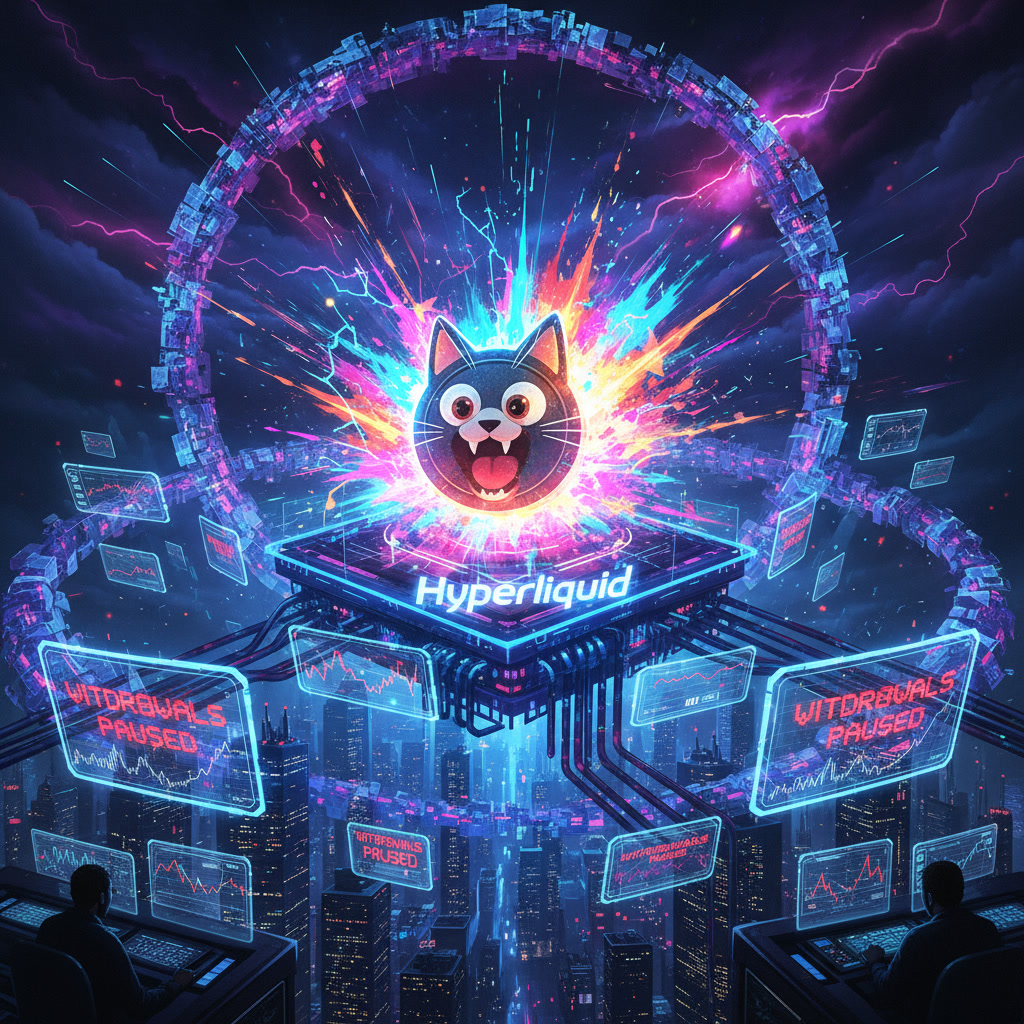
In an incident that underscores the volatile nexus of memecoins, leveraged trading and decentralised finance infrastructure, the perpetual-futures exchange platform Hyperliquid temporarily halted deposits and withdrawals after a dramatic trading saga involving the meme token POPCAT. The chain of events highlights vulnerabilities that even the most advanced DeFi systems can face when dealing with large, coordinated trades in highly speculative assets.
The Sequence of Events
On 12 November 2025, Hyperliquid indicated that its bridge on the Arbitrum network had been temporarily paused for deposits and withdrawals. According to on-chain analysts, the trigger for the disruption was a suspected manipulation scheme involving POPCAT, in which a trader reportedly withdrew about US$3 million in USDC from the centralised exchange OKX, split the funds across 19 different wallets, and initiated large long positions in POPCAT on Hyperliquid.
The trader’s strategy purportedly involved placing roughly US$20 million in buy orders at about US$0.21 per token, thereby erecting a significant “buy wall” to support or boost the memecoin’s price. When that buy wall was removed, the POPCAT price collapsed, triggering a cascade of liquidations. According to reports, the combined position across those wallets grew to around US$30 million.
Because of the resulting liquidations, Hyperliquid’s community-owned liquidity vault — known as the Hyperliquidity Provider (HLP) — absorbed approximately US$4.9 million in losses. In response, the platform appears to have invoked its “EmergencyLock” function, halting the bridge on Arbitrum for USDC deposits/withdrawals, thereby attempting to stop further fallout.
Implications for Hyperliquid and DeFi
Risk-Management Strain
The incident brings into sharp relief the challenge for decentralised derivatives platforms: when an actor can coordinate large leveraged trades and manipulate market sentiment, even community-governed vaults and protocols can be exposed. As one analysis put it, the episode “exposes DeFi’s immaturity in risk management.”
Repeated Patterns
This is not the first time Hyperliquid has been impacted by such an event. Earlier in 2025, a similar manipulation involving the memecoin JELLYJELLY led to unrealised losses of approximately US$12 million. The recurrence of such incidents may raise questions over whether protocols dealing with speculative assets have sufficient guardrails in place.
Platform Reputation & Decentralisation Questions
By manually closing the positions and invoking emergency protocols, Hyperliquid has drawn scrutiny regarding how “decentralised” its operations truly are when extreme situations arise. Some observers note that while the platform brands itself as a decentralised perpetual exchange, episodes like this highlight that operational control and risk intervention still require centralised decisions.
Impact on Users and Market Sentiment
For users, the halting of withdrawals—even if only temporarily—is cause for concern, as it interferes with access to funds during volatile market conditions. While Hyperliquid reported no indication of a broader hack or mass asset outflow (e.g., the USDC bridge reportedly still held a large balance) the mere pause may erode trust in decentralised platforms handling volatile assets. Furthermore, the incident may lead to increased caution among liquidity providers and traders regarding risk in leveraged memecoin trades.
What Led to the Vulnerability?
Several factors appear to have contributed to how this event played out:
-
High leverage exposure: Large long positions on a volatile memecoin increased the system’s sensitivity to price shocks.
-
Low liquidity or manipulable market structure: For a meme token like POPCAT, liquidity may be shallow enough that coordinated trades can meaningfully affect price.
-
Use of multiple wallets: Splitting the funds across many wallets may have helped avoid immediate detection or trigger of risk controls until the collapse.
-
Insufficient guardrails or risk thresholds: The size of the exposure suggests that existing limits or automatic safeguards did not fully prevent the scale of the event.
The Bigger Picture: Lessons for DeFi
-
Protocols need stronger risk-controls: As DeFi platforms expand into ever more speculative assets, the margin for error narrows. Built-in mechanisms to monitor, flag and limit unusually large trades may become more important.
-
Liquidity providers must understand systemic risk: The HLP vault’s loss underscores that even passive liquidity-provision involves exposure to systemic events beyond normal market risk.
-
User awareness is key: Traders and liquidity providers should remain aware that decentralised systems—even when labelled as “trustless”—still rely on rules, architecture and human decisions under duress.
-
Transparency and communication matter: The brief notice of “maintenance” was how the withdrawal freeze was first communicated. Clear and timely updates help maintain trust in crisis scenarios.
Conclusion
The Hyperliquid-POPCAT event is more than just another story in the wide world of crypto drama. It serves as a potent case study of how a seemingly playful or speculative asset (a memecoin) can trigger a serious disruption in an advanced trading platform. The fact that a trader reportedly orchestrated a multi‐wallet strategy, placed tens of millions in trades, and initiated a buy-wall-then-dump scenario resulting in multi-million-dollar losses for a liquidity pool makes clear that DeFi infrastructures are still navigating how to handle such extremities.
For Hyperliquid, the incident will likely accelerate discussions around risk design, decentralisation versus control, and how to balance openness with protection. For the broader ecosystem, it’s a reminder that high leverage + low liquidity + speculative assets = system stress. As the DeFi space matures, many of the guardrails taken for granted in traditional finance may have to be built, tested and repeatedly hardened.
Ready to start your cryptocurrency journey?
If you’re interested in exploring the world of crypto trading, here are some trusted platforms where you can create an account:
- Binance – The world’s largest cryptocurrency exchange by volume.
- Bybit – A top choice for derivatives trading with an intuitive interface.
- OKX – A comprehensive platform featuring spot, futures, DeFi, and a powerful Web3 wallet.
- KuCoin – Known for its vast selection of altcoins and user-friendly mobile app.
These platforms offer innovative features and a secure environment for trading and learning about cryptocurrencies. Join today and start exploring the opportunities in this exciting space!
 Want to stay updated with the latest insights and discussions on cryptocurrency?
Join our crypto community for news, discussions, and market updates: CryptoBCC on Youtube | Telegram | Facebook | Discord | X(Twitter)
 For collaborations and inquiries: CryptoBCC.com@gmail.com
Disclaimer: This is not investment advice. Cryptocurrency investments carry high risk. Always conduct your own research.