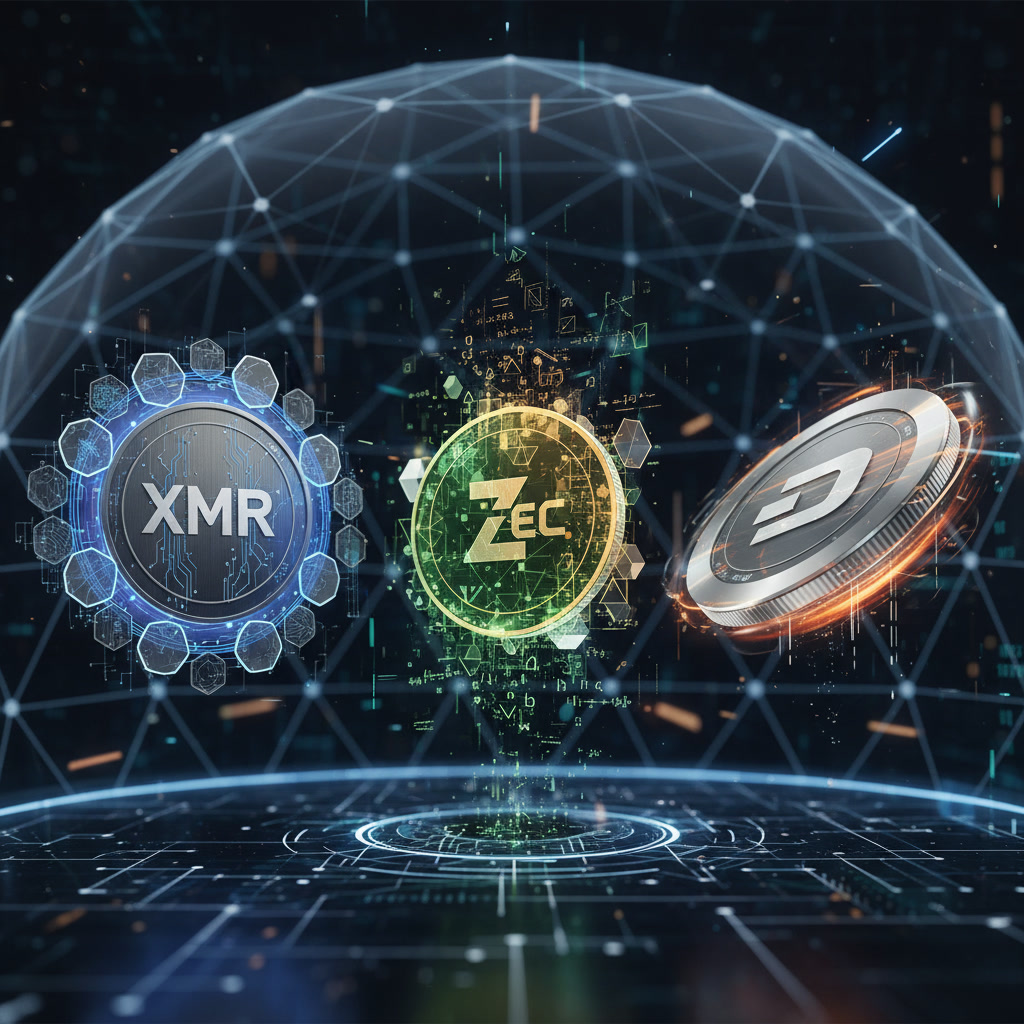
Privacy coins have emerged as a powerful answer to blockchain transparency, offering users true financial anonymity in an increasingly surveilled digital landscape. As regulatory pressure intensifies and exchanges continue delistings, three privacy-focused cryptocurrencies stand out for their technological innovation and market adoption: Monero (XMR), Zcash (ZEC), and Dash (DASH). Together, these projects represent different approaches to solving the same fundamental challenge—protecting user privacy while maintaining blockchain security and verifiability.
1. Monero (XMR): Privacy by Default
Market Position: Ranked #22 with approximately $7.1 billion market cap as of November 2025
Monero has established itself as the gold standard for privacy cryptocurrencies by making anonymity mandatory rather than optional. Unlike most blockchains where privacy is a feature you can choose, every single Monero transaction automatically obscures the sender, recipient, and amount.
How Monero Works
Monero employs a sophisticated combination of four core privacy technologies that work in concert to create comprehensive transaction anonymity:
Ring Signatures: When you send Monero, your transaction gets mixed with 15 decoy transactions from the blockchain, creating a “ring” of 16 possible spenders. This makes it cryptographically impossible for observers to determine which transaction is real—they all appear equally valid. The network upgraded to a ring size of 16 in 2022, providing stronger anonymity than the previous size of 11.
Stealth Addresses: Every time someone sends you XMR, your wallet automatically generates a unique, one-time address for that specific transaction. This means even if someone knows your public Monero address, they cannot see incoming transactions on the blockchain or determine your balance. Each transaction appears to go to a completely different address.
Ring Confidential Transactions (RingCT): Implemented in 2017, RingCT hides the transaction amounts being transferred. While all transactions are recorded on the blockchain, observers have no way to determine how much Monero is being sent in any given transaction.
Dandelion++: This network-level privacy feature protects against IP address tracking. When you broadcast a transaction, Dandelion++ first routes it through trusted peers in an untraceable “stem phase” before broadcasting to the wider network, making it nearly impossible to link transactions to specific IP addresses.
Technical Foundation
Monero operates on the CryptoNote protocol, originally proposed anonymously in 2012 and continuously improved since. The blockchain uses RandomX, a proof-of-work mining algorithm designed to resist ASIC mining and keep mining decentralized by favoring general-purpose CPUs. This prevents large mining operations from dominating the network and allows regular users to participate in securing the blockchain.
Strengths and Challenges
Monero’s mandatory privacy creates the strongest anonymity set in cryptocurrency—because every transaction uses the same privacy features, there’s no way to identify which users are seeking privacy versus normal usage. However, this uncompromising approach to privacy has led to significant regulatory scrutiny. Major exchanges including Binance, OKX, and Poloniex have delisted XMR, with 73 exchanges worldwide having removed privacy coins by 2025—a 43% increase from 51 in 2023.
Despite delistings, Monero maintains strong grassroots support, with peer-to-peer markets like LocalMonero seeing a 19% uptick in activity following centralized exchange restrictions.
2. Zcash (ZEC): Optional Privacy with Zero-Knowledge Proofs
Market Position: Ranked #25 with approximately $8.5-10.6 billion market cap as of November 2025
Zcash takes a fundamentally different approach by offering selective transparency—users can choose whether to make transactions public or completely private. This flexibility has made Zcash attractive for both privacy-conscious users and those seeking regulatory compliance.
How Zcash Works
At the heart of Zcash’s privacy technology lies zk-SNARKs (Zero-Knowledge Succinct Non-Interactive Arguments of Knowledge). This groundbreaking cryptographic method allows the network to verify that a transaction is valid without revealing any information about the sender, recipient, or amount.
Think of zk-SNARKs like a sealed verification system: you can prove you have sufficient funds and haven’t double-spent without revealing your account balance, transaction history, or counterparty identities. The blockchain records only an encrypted note and a mathematical proof confirming the transaction follows all monetary rules.
Two-Address System
Zcash operates with two distinct types of addresses:
Transparent Addresses (t-addresses): These work like Bitcoin addresses, where all transaction details are publicly visible on the blockchain. They’re useful for exchanges and situations requiring transparency.
Shielded Addresses (z-addresses, u-addresses): These utilize zk-SNARKs to keep sender, receiver, and amount completely private. Transactions between shielded addresses provide Zcash’s full privacy guarantees.
Users can send funds between any combination of transparent and shielded addresses, though moving from transparent to shielded (“shielding”) or shielded to transparent (“deshielding”) can introduce linkability concerns if not done carefully.
Growing Adoption of Privacy
As of October-November 2025, Zcash has achieved a significant milestone: over 4.5 million ZEC (approximately 28-30% of total supply) is now held in shielded addresses—the highest level in the network’s history. This represents a dramatic increase, with approximately 1 million ZEC moving into shielded pools in just three weeks during October 2025. Usage of shielded transactions rose 36% month-over-month in October 2025, driven by wallet improvements and cross-chain integrations.
This growth signals genuine adoption of privacy technology rather than mere speculation. As developer Victor noted: “Typical crypto behavior: pump → exchange → dump. Zcash behavior: pump → shield → hodl. This isn’t speculation; it’s the adoption of privacy technology”.
Technical Advantages
Compared to Monero’s ring signatures, zk-SNARKs offer a more scalable and computationally efficient solution for privacy. Zcash operates on a Proof-of-Work consensus similar to Bitcoin, with 80% of block rewards going to miners and 20% allocated to development funding.
The Flexibility Trade-off
Zcash’s optional privacy is both a strength and a limitation. The flexibility appeals to users and institutions concerned about regulatory compliance, but it also means the effective anonymity set is smaller when many users stay in transparent mode. As of 2017-2018, only about 3-4% of Zcash was in the shielded pool, though this has grown substantially to 28-30% by late 2025.
The project has faced delisting pressures similar to Monero, with exchanges requiring special implementations to comply with EU regulations. Community discussions have explored technical solutions, though major exchanges like Binance have rejected some proposals.
3. Dash (DASH): Practical Privacy for Payments
Market Position: Ranked #78 with approximately $920-925 million market cap as of November 2025
Dash positions itself as “digital cash” focused on fast, low-cost payments with optional privacy through its PrivateSend feature. Launched in January 2014 as a fork of Litecoin, Dash has evolved into a comprehensive payment-focused cryptocurrency with privacy as one of several features rather than its primary mission.
How Dash Works
PrivateSend Technology: Dash’s privacy feature is based on CoinJoin, a mixing protocol where multiple users combine their transactions to obscure the origin of funds. The process works as follows:
-
Denomination Breaking: Your funds are broken down into standard denominations (10, 1, 0.1, 0.01, or 0.001 DASH) to enable mixing with other users
-
Masternode Mixing: Your wallet sends mixing requests to masternodes (special nodes requiring 1,000 DASH collateral). The request is anonymous—the masternode doesn’t know who sent it
-
Multi-User Pooling: At least three users mixing the same denomination are matched together. The masternode shuffles the inputs and returns equal outputs to each participant’s new addresses
-
Multiple Rounds: Users can configure 1-16 rounds of mixing. Each additional round increases anonymity while incurring a small fee (approximately 0.0001 DASH per 10 rounds on average)
Two-Tier Network Architecture
Dash operates on a unique two-tier network structure:
First Tier (Miners): Perform standard proof-of-work mining operations to secure the blockchain and process transactions.
Second Tier (Masternodes): Provide advanced services including PrivateSend mixing, InstantSend (instant transaction settlement), ChainLocks (instant blockchain immutability), and decentralized governance.
This architecture enables features beyond privacy, positioning Dash as a comprehensive payments platform rather than solely a privacy coin.
Privacy Limitations
While PrivateSend provides useful obfuscation, it’s important to understand its limitations:
-
Optional Not Mandatory: Privacy is opt-in, and Dash transactions are unmixed by default. This means the anonymity set is limited to only those users actively choosing privacy
-
CoinJoin-Based: The mixing mechanism is functionally similar to Bitcoin mixers and CoinJoin implementations like Wasabi Wallet. From a technical standpoint, Dash’s privacy is no greater than Bitcoin’s, making the “privacy coin” label somewhat of a misnomer
-
Weaker Cryptographic Privacy: Compared to Monero’s ring signatures or Zcash’s zk-SNARKs, CoinJoin mixing provides simpler but less robust anonymity from a pure cryptographic standpoint
Payment-First Design
Dash’s real strength lies in its payment usability and speed rather than maximum privacy. The project emphasizes:
-
Fast transactions through InstantSend
-
Low fees for mixing (no fees for PrivateSend mixing itself, unlike most Bitcoin mixers)
-
User-friendly wallet integration
-
Decentralized governance with 10% of block rewards funding development
Regulatory Landscape and Market Dynamics
All three privacy coins face mounting regulatory pressure as governments worldwide increase scrutiny of anonymity-enhancing cryptocurrencies:
-
73 exchanges worldwide have delisted privacy coins by 2025, up 43% from 51 in 2023
-
Major platforms including Binance, OKX, Kraken, and Poloniex have removed XMR, ZEC, and DASH from various regions
-
Japan prohibits all privacy coin trading on registered exchanges
-
South Korea’s top five exchanges removed privacy coins in Q1 2025
-
EU’s MiCA regulation requires exchanges to identify holders of crypto-assets with “inbuilt anonymisation functions”
Despite delistings, privacy coins have seen renewed interest in 2025. Zcash surged over 700% from September to November 2025, with other privacy tokens like Dash (+141%), Decred (+96%), and ZKsync (+122%) also seeing significant gains. This “privacy coin renaissance” reflects growing concerns about financial surveillance and the value of transactional anonymity in an increasingly monitored digital world.
Comparing the Three Approaches
| Feature | Monero (XMR) | Zcash (ZEC) | Dash (DASH) |
|---|---|---|---|
| Privacy Model | Mandatory, every transaction private | Optional, user chooses transparent or shielded | Optional mixing via PrivateSend |
| Core Technology | Ring signatures, RingCT, stealth addresses, Dandelion++ | zk-SNARKs zero-knowledge proofs | CoinJoin-based mixing through masternodes |
| Privacy Strength | Strongest—every transaction uses full privacy features | Very strong when using shielded addresses; weaker if transparent | Moderate—similar to Bitcoin mixers |
| Anonymity Set | Entire network (all transactions) | 28-30% of supply in shielded pool (growing) | Limited to PrivateSend users only |
| Primary Focus | Maximum privacy and fungibility | Selective transparency with privacy option | Fast, user-friendly payments with privacy feature |
| Computational Cost | Moderate—efficient after Bulletproofs upgrade | Higher—30-60 seconds to create shielded transactions | Low—simple mixing process |
| Regulatory Status | Most heavily restricted; delisted from major exchanges | Moderate pressure; some compliance solutions explored | Lower scrutiny due to optional privacy |
| DeFi Integration | Limited—focused on payments and privacy | Growing—cross-chain integrations like ZPay on Solana | Moderate—primarily payment ecosystem |
Conclusion
These three privacy coins represent distinct philosophies in protecting financial privacy:
Monero offers the most uncompromising approach—privacy by default for every transaction, making it the choice for users who prioritize maximum anonymity above all else. Its mandatory privacy creates the strongest fungibility, but also attracts the most regulatory scrutiny.
Zcash provides flexibility through optional privacy backed by cutting-edge cryptography. Its zk-SNARKs technology enables complete privacy when needed while allowing transparency for compliance situations. The growing adoption of shielded transactions (30% of supply by late 2025) demonstrates increasing trust in its privacy infrastructure.
Dash takes a pragmatic approach, positioning privacy as one feature within a broader payments-focused ecosystem. While its PrivateSend offers less robust anonymity than Monero or Zcash, Dash excels in usability, transaction speed, and practical payment applications.
As blockchain surveillance technology advances and regulatory frameworks evolve, these privacy coins represent critical tools for financial autonomy. The choice between them depends on your specific needs: maximum anonymity (Monero), flexible compliance (Zcash), or payment convenience with optional privacy (Dash). Together, they demonstrate that privacy in cryptocurrency is not a single solution, but a spectrum of approaches balancing anonymity, usability, and regulatory considerationsrations.
Ready to start your cryptocurrency journey?
If you’re interested in exploring the world of crypto trading, here are some trusted platforms where you can create an account:
- Binance – The world’s largest cryptocurrency exchange by volume.
- Bybit – A top choice for derivatives trading with an intuitive interface.
- OKX – A comprehensive platform featuring spot, futures, DeFi, and a powerful Web3 wallet.
- KuCoin – Known for its vast selection of altcoins and user-friendly mobile app.
These platforms offer innovative features and a secure environment for trading and learning about cryptocurrencies. Join today and start exploring the opportunities in this exciting space!
 Want to stay updated with the latest insights and discussions on cryptocurrency?
Join our crypto community for news, discussions, and market updates: CryptoBCC on Youtube | Instagram | Telegram | Pinterest | Facebook | Discord | Tiktok | Threads | X(Twitter).
 For collaborations and inquiries: CryptoBCC.com@gmail.com
Disclaimer: This is not investment advice. Cryptocurrency investments carry high risk. Always conduct your own research.