In the rapidly evolving world of blockchain, two titans stand out at the forefront of the layer-1 protocol race: Ethereum and Solana. While casual observers often debate simply which is “better,” the real story is far richer: by 2025, Ethereum and Solana have adopted fundamentally different architectures and growth strategies. The question now is not just who is faster, but who is more efficient, scalable, and suited to the myriad applications of Web3.
Modular vs Monolithic: Two Schoolsof Thought
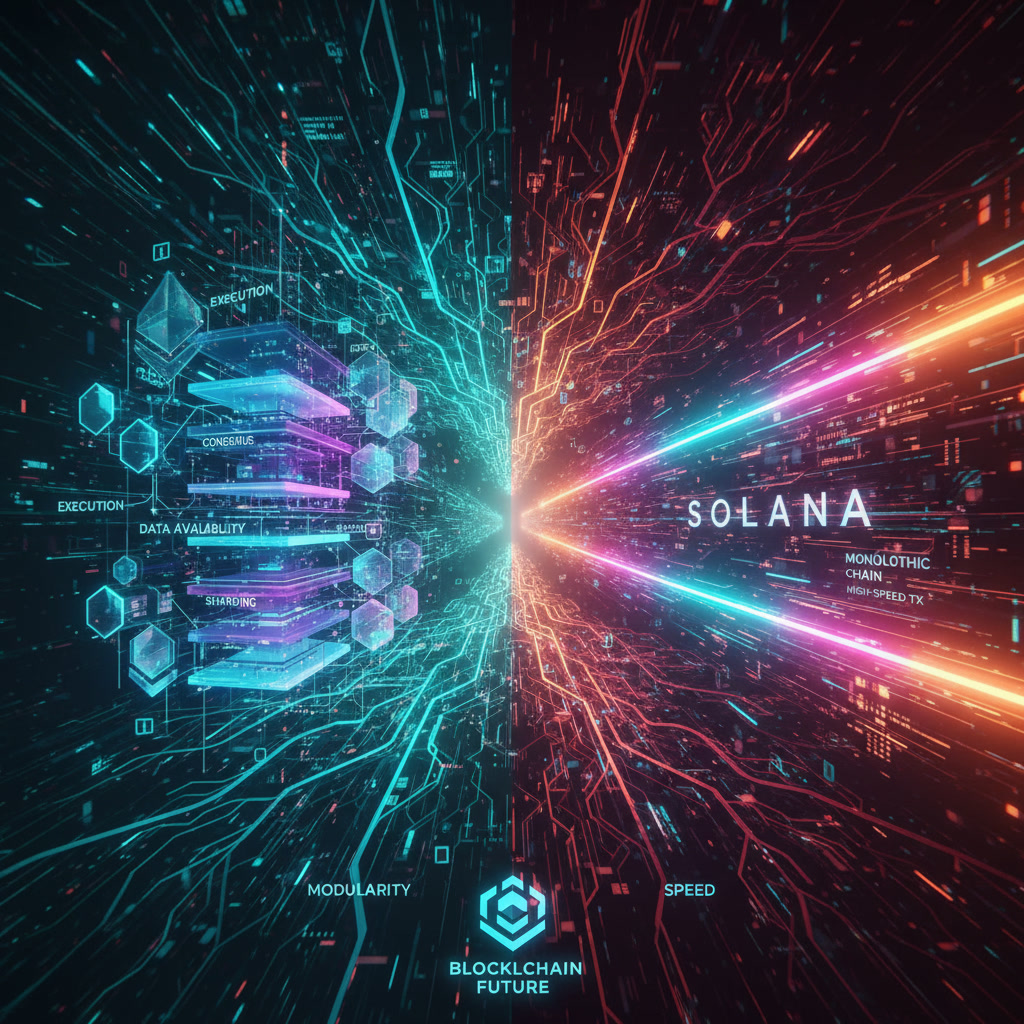
Ethereum has long abandoned the notion of a single “do-everything” chain. Instead, it has positioned itself as a settlement layer—the foundation upon which modular, Layer-2 roll-ups operate.
In contrast, Solana doubles down on a monolithic architecture—processing settlement, execution and data availability all within a unified chain, aiming for ultra-low latency and high throughput.
This divergence is more than academic. It reflects fundamentally different trade-offs:
-
Solana prioritizes speed and simplicity: transactions settle on the mainchain in ~400 ms (under ideal conditions).
-
Ethereum, via roll-ups, separates execution (L2) from settlement (L1). Finality on L1 comes when the roll-up posts its state root and contestation windows expire.
In short: Solana seeks “everything in one place, super fast.” Ethereum says: “Let’s split it up, optimize each layer separately.”
Real-World Performance: Fees, Bottlenecks & Risk
When it comes to cost and user experience, the two ecosystems diverge again.
Solana
-
Very low transaction fees: a base fee of 5,000 lamports (≈ $0.0001) per signature, plus priority-fees in congestion.
-
Nearly all standard transactions cost under one cent. That makes it very attractive for high-volume or microtransaction use-cases.
-
Downside: when Solana fails, the failure tends to affect the entire chain (since everything runs on that single monolithic layer). For example: a 4 h46 m outage on 6 February 2024 caused by software issues.
Ethereum (via L2 roll-ups)
-
Fees have dropped significantly after upgrades like Dencun (Mar 2024) and Pectra (May 2025) — sending transactions can cost only a few cents on major roll-ups.
-
Because execution happens off-chain (on L2), a sequencer failure affects that roll-up rather than the entire ecosystem—so risk is more compartmentalised.
-
But there are trade-offs: optimistic roll-ups may require a 7-day withdrawal delay (due to the challenge period), and even ZK-roll-ups, while faster, may still take 15 minutes to several hours.
Use-Case Fit: Which To Build On?
For developers and businesses asking “Where should I build?”, the answer depends a lot on the application’s specific requirements. Here’s a rough breakdown:
-
High-frequency trading, market-making, latency-sensitive applications
These lean toward Solana thanks to its ultra-low latency and unified chain design. -
Decentralised applications (DeFi), payments, social networks
These may find better fit in Ethereum’s roll-up ecosystem, especially where composability, security and a broad developer ecosystem matter. If the application only needs occasional settlement with L1, an L2 gives competitive costs and “instant” feel. -
Simple settlement / payment rails
Solana offers ease of understanding—no bridging, no separate L2. Finality and settlement happen on the same chain.
In short, the answer isn’t “Ethereum or Solana” in the abstract—it’s “Which architecture best matches your application’s demands in cost, latency, composability and security?”
What’s Coming Next? The Upgrades to Watch
Both ecosystems are actively evolving:
-
Solana is investing in its Firedancer client (by Jump Crypto) which aims to significantly improve decentralisation (multiple clients) and further slash latency (~150 ms target) within its monolithic design.
-
Ethereum has major upgrades in the pipeline:
-
Pectra (May 2025) increased blob capacity.
-
Fusaka (Q4 2025) introduces PeerDAS, allowing nodes to validate data without downloading all blob data—reducing storage costs.
-
Glamsterdam (2026) will bring PBS & inclusion lists, enhancing censorship-resistance.
-
These upgrades suggest that Ethereum is doubling down on its modular design—improving efficiency and lowering cost—while Solana is iterating to maintain its lead in speed and simplicity.
The Big Picture: Why It Matters
By 2026 and beyond, the key question won’t be merely “Which chain is faster?” but “Which architecture translates into real-world effectiveness for the right applications?” With speed, cost, reliability and ecosystem support in mind, developers and users will increasingly gravitate toward systems that match their needs—not just raw metrics.
For users, the result is better experience: lower fees, faster confirmation, less friction. For developers, it means choices: either build atop a lightning-fast monolith (Solana) or leverage a highly modular, composable ecosystem (Ethereum + L2s).
Both models have merit—and indeed both ecosystems are likely to thrive, but in different niches. Solana’s strength lies in unified throughput; Ethereum’s in modular resilience and broad composability.
Final Thoughts
In the race of layer-1 protocols, Ethereum and Solana present two divergent evolutionary paths: one modular, one monolithic. The right answer is not “one beats the other” but “which fits best for the job.” As we approach 2026, expect to see clearer winners in specific segments: for example, high-frequency or micro-payment systems may favour Solana, while complex DeFi ecosystems may gravitate to Ethereum’s roll-up stack.
Ultimately, the future of Web3 may not be about a single winner—rather, a diversity of winners, each optimized for distinct niches, powered by different architectural philosophies.
Ready to start your cryptocurrency journey?
If you’re interested in exploring the world of crypto trading, here are some trusted platforms where you can create an account:
- Binance – The world’s largest cryptocurrency exchange by volume.
- Bybit – A top choice for derivatives trading with an intuitive interface.
- OKX – A comprehensive platform featuring spot, futures, DeFi, and a powerful Web3 wallet.
- KuCoin – Known for its vast selection of altcoins and user-friendly mobile app.
These platforms offer innovative features and a secure environment for trading and learning about cryptocurrencies. Join today and start exploring the opportunities in this exciting space!
 Want to stay updated with the latest insights and discussions on cryptocurrency?
Join our crypto community for news, discussions, and market updates: CryptoBCC on Youtube | Instagram | Telegram | Pinterest | Facebook | Discord | Tiktok | Threads | X(Twitter).
 For collaborations and inquiries: CryptoBCC.com@gmail.com
Disclaimer: Always do your own research (DYOR) and ensure you understand the risks before making any financial decisions.